Teaching With Style: Math

Showing posts with label Math. Show all posts

K-2 teachers love to teach using picture books!  Here is a list of books suggested by the Math Learning Center for teaching mathematics concepts.


Counting & Number Sense
Ten, Nine, Eight by Molly Bang
The Very Hungry Caterpillar by Eric Carle
1,2,3 to the Zoo by Eric Carle
Let’s Count by Tana Hoban
Two Ways to Count to Ten by Ruby Dee
12 Ways to Get to 11 by Eve Merriam (used in Bridges Grade 2)
365 Penguins by Jean-Luc Fromental

Adding & Subtracting
Each Orange Had 8 Slices by Paul Giganti
Rooster's Off to See the World by Eric Carle
12 Ways to Get to 11 by Eve Merriam (used in Bridges Grade 2)

Multiplying
Two of Everything: A Chinese Folktale by Lily Toy Hong
Amanda Bean's Amazing Dream by Cindy Neuschwander
Anno's Mysterious Multiplying Jar by Mitsumasa Anno

Dividing
One Hundred Hungry Ants by Elinor J Pinczes (used in Bridges Grade 2)
The Doorbell Rang by Pat Hutchins


Time
Bats Around the Clock by Kathi Appelt
Telling Time with Big Mama Cat by Dan Harper
Cluck O'Clock by Kes Gray

Money
Benny's Pennies by Pat Brisson (used in Bridges Grade K)
Jenny Found a Penny by Trudy Harris
Jelly Beans for Sale by Bruce McMillan
Arthur’s Funny Money by Lillian Hoban (used in Bridges Grade 2)


Problem Solving
Anno's Hat Trick by Mitsumasa Anno
The Grapes of Math by Greg Tang


Fractions
Jump, Kangaroo, Jump! by Stuart J. Murphy
Fraction Action by Loreen Leedy
Fraction Fun by David A. Adler


Geometry
So Many Circles, So Many Squares by Tana Hoban
A Cloak for the Dreamer by Aileen Friedman (used in Bridges Grade 2)
Shapes, Shapes, Shapes by Tana Hoban
Cubes, Cones, Cylinders, & Spheres by Tana Hoban


Measurement
How Big Is a Foot? by Rolf Myller
Measuring Penny by Loreen Leedy

Millions to Measure by David M. Schwartz (used in Bridges Grade 5)
Counting on Frank by Rod Clement

What are your favorite books for teaching math? 


Like many teachers, I'm all about PD and planning over the summer.  One subject that hasn't been going so well in my room for the past few years is math, and I want to do something about it! We use a state approved curriculum called Stepping Stones that is all online.  Students have workbooks, but there is not a teacher's guide or independent activities.  I can download daily lesson plans, and need to supplement extra independent activities outside of the workbooks.  It takes a lot of extra work for me to plan for math and I don't feel like my students really get all the concepts after I give the unit tests.

I've been a huge fan of the Daily 5 and CAFE frameworks for quite some time now and have utilized them in my reading instruction.  See my previous posts for a First Edition book study: Daily 5 book Study Chapter 1, Daily 5 Book Study Chapter 2, Im Lovin' Daily 5, Meeting The Sisters

I had heard about Math Daily 3 a few years ago and implemented a version of it, but then abandoned when I moved into my current position.  I'm not really sure why, but all I know is what I'm doing now doesn't make me feel good as a teacher.  I know I need to focus on improving my math instruction.

I get the weekly emails from The Sisters and saw that they offer online courses now.  I quickly signed up for the Math Daily 3 course and finally dug into my Second Edition book that contains information about implementing the Math Daily 3.  The course includes weekly videos, LMS platform where I can ask questions and connect with other participants, downloads, and a 3-month subscription to the Daily CAFE website.

From reading the new book, I have found some changes that the Sisters have made to their Daily 5 framework from the first book.  I love that these ladies are still in classrooms, working with real kids, and making improvements to their practices over the years.  Isn't that what successful teachers do?

There is a whole chapter dedicated to their core beliefs as teachers:
  1. Trust and Respect
  2. Community
  3. Choice
  4. Accountability
  5. Brain Research
  6. Transitions and Brain/Body Breaks
As a constructivist teacher, I believe in these principles as well.  They align so well with the work I do in arts-integration, OCDE Project GLAD (R), and also my recent training with Responsive Classrooms and their positive discipline techniques.  Its refreshing to feel so validated with my practices when reading professional books and literature!

The Sisters believe in a 10-step process to building stamina and holding students accountable for their choices during independent work time.  You can get a printable version of these steps on their website {here}. I love how reflection is built into this plan and how children clearly see and know what is expected of them.
  1. Identify What is to Be Taught
  2. Set a Purpose and Create a Sense of Urgency
  3. Record Desired Behaviors on an I-Chart
  4. Model Most-Desirable Behaviors
  5. Model Least-Desirable Behaviors, Then Most-Desirable
  6. Place Students Around the Room
  7. Practice and Build Stamina
  8. Stay Out of the Way
  9. use a Quiet Signal to Bring Students Back to the Gathering Place
  10. Conduct a Group Check-In; Ask "How Did It Go?"

So just like how teachers post reading strategies they've taught whole group on a CAFE board, teachers make a math board and post games they have taught whole group that students can choose from. It's important to organize materials so students can quickly and easily get everything they need to play the games.  

I have some Math Station Posters in my TpT store that would definitely work for Math Daily 3.  I actually just updated them to include Math Writing.  I had used them for station rotations, but they could be set up as a math board, too. 

I also have math tub labels for organizing your manipulatives.  I think visual labels are so important in lower grades, but also in upper grades for EL students who are still learning foundational English.  

How does the Math Daily 3 fit into your math instruction routines? 


I recently had a DonorsChoose.org project funded that I'm really excited about - Legos to teach place value! I got the idea from my friend Jen who blogged about it over on Hawaii's HSTA HYPE blog.  Basically, instead of using base ten blocks for place value, you use Legos.  Here's why Legos are better:
  • Many students have Legos at home and can use them while doing homework
  • Students have background knowledge of Legos and already love using them
  • Legos create a novelty and bring some fun into your math class

I was intrigued by the idea, so I wrote up a project.  Here is what I requested:

  • Akro-Mils 24 Drawer Hardware and Craft Cabinet
  • 2 sets of Drawer Separators 
  • 2 sets of Multi-colored 10"x10" Base Plates
  • Brick Separators
  • 1000 1x1 Lego-Compatible Bricks

Did you know that The Lego Store is now an approved vendor for DonorsChoose? So excited about that! Unfortunately, I had to write a special request because it was a few months ago.  

I went into the Pick-a-Brick section of their website and ordered 240 white 2x10 plates (part # 383201) and 200 gray 1x10 bricks (part # 4211521).  Using five 2x10 plates lined up on top and 3 spread out on the bottom to secure together, I was able to create 10x10 pieces to use as the hundreds pieces.  I got this great idea from Jen, too. 


In our math curriculum, we are currently working on standard 1.NBT.C.4: Add within 100, including adding a two-digit number and a one-digit number, and adding a two-digit number and a multiple of 10. Understand that in adding two-digit numbers, one adds tens and tens, ones and ones; and sometimes it is necessary to compose a ten.

It's a long standard and it's a hard one for kids who are still very literal.  We've been counting the days in school using base ten blocks every day, but they still don't understand that 7 tens and 4 ones is the same as 6 tens and 14 ones.  Using Legos is absolutely helping.  Here are some photos from class as we were adding two 2-digit numbers and regrouping.


You might be wondering about storage and management. I got the drawer organizer so the kids have easy access to the materials and can grab them when they need them.  We have to practice with them whole group so they will know how to use them independently.  I have 16 sets of tens and ones, but 20 students.  So some of the students share.  We call that "making a strong choice to share" and I praise the ones who choose to share so that others can have their own.  We like making strong choices in my room and doing something that's best for everyone even if you don't want to :) 


I put the brick separators in a little container on the top.  I put the base plates 
in that green scrapbook paper container at the bottom of this pic.

I made these labels, laminated them, and stuck them on to the drawers with double sided tape.  You are welcome to grab this as a freebie! 


Let me know if you end up making a Lego cabinet by tagging me in a pic on IG and using the hashtag #learningwithlegos.  I bet your students will love it! 


As a part of Hawaii's new educator evaluation system, each teacher has to write a Student Learning Objective.  We choose a standard to work on almost all year.  We pre-test to set a baseline and then predict how much progress each child will make throughout the year.  We teach, review, formatively assess, review some more, and then we give the final assessment.  The percentage of students who met the benchmark we predicted at the beginning of the year is part of how we are evaluated as successful educators.

My grade level chose place value, specifically Common Core standard 1.NBT.2, to focus on for our Student Learning Objective.  Many of my kids were confused as to how to decompose two digit numbers and are clueless about expanded form.

To help practice each day, I added some place value routines to our calendar time.
Check out my Calendar Sets on TpT!

Here is our routine, all lead by the weekly calendar helper.
  1. Sing the Days of the Week song (helper gets to choose either the Addams' Family tune or She'll be Comin' Round the Mountain)
  2. Practice saying the date as the calendar helper points to it's components.  For example, on March 23rd we said "Today is Monday (helper pointed to the Monday card across the top of the calendar) March (pointed to the March month card at the top) 23rd (pointed to today's card that says 23) 2015 (points to the year card next to the month card at the top).  This helps kids practice saying the date as a complete sentence and also the grammar of saying March 23rd instead of March 23.  
  3. I then change the day's number at the top (3-23-15) so they learn how we write the date.  Now we've practiced how to say it in words and how to write it in numbers.  That's why I have a 3 card next to the month at the top of the calendar pocket chart, to correspond with the 3 in our written date.  
  4. I then have the kids tell me how many tens and how many ones are in today's date number.  I wrote this in the same format as our math curriculum, Origo's Stepping Stones.  They call that little 2-box graph an "expander".  Kids start by making expanders so they can see how 2 tens and 3 ones can be put together to make 23.  

  5. Kids bring their whiteboards, markers, and erasers with them to calendar each day.  Once we are done with all the calendar business, they then write number sentences that equal the day's number.  So for the day I took this picture, they all equaled 23.  After they have each written a few, they share out.  The calendar helper calls on 2 girls and 2 boys to share and write's then on a large whiteboard for everyone to see.  There needs to be 2 addition and 2 subtraction sentences.  When all 4 are written on the board, the help uses a pointer to lead the class in reading all 4 number sentences together.   
  6. We then move to the Hundred's Chart and the kids practice skip counting.  It's always by 5's but sometimes we start at 5 and count up and sometimes we start at 100 and count down.  Counting down was SUPER hard for then at the beginning of the year.  Now they are pros! 
  7. We then move to the place value chart and add a number to keep track of how many days we've been in school.  They add a number card and also add a place value cube.  Then there are 10 ones cubes, they trade them out for a rod.  When there are 10 rods, they trade them out for a flat. 
  8. We then sing the Doubles Rap to help us memorize the doubles facts.  We sing it every.single.day.  They even made up their own motions to the lyrics.  So stinkin' cute! 
    From First Grade Fresh
  9. Lastly, we count to ten in Hawaiian.  I use the posters from Surfin' Through Second.  I love this part of our routine because even though my school has a Hawaiian Immersion program, the regular classes don't get much Hawaiian instruction, it's up to the individual teacher.  This helps me (non-Hawaiian haole lady) connect the language to math.  
This routine takes 10-15 minutes and the kids are seriously sad if we skip it! They love knowing what comes next and the calendar helper LOVES being the leader for the day!

You can see a few of the activities incorporate place value practice.  That's how I sneak it it EVERYDAY! :)

Another thing I do pretty much every day is math centers.  I do four different centers: Math with the teacher (small group lesson), Math by Myself (Math journal work), Math with Technology (X-tra Math and then SumDog), and Math with a Buddy (math center games).


Click on the picture to check out these posters on TpT! 

Of course it's easy to differentiate and provide practice and instruction for place value in the teacher group, because I get to pick what the kids do that week.  That's when I would introduce skills, such as expanded form, that are not necessarily covered in our whole group math curriculum.  But it's also easy to do all that during Math with a Buddy, AKA center games.  

I used this wooden stand and containers from Lakeshore Learning for my math centers.  The green buckets contained activities for Operations and Algebraic Thinking standards.  The blue containers had activities for Numbers in Base Ten standards.  The orange buckets are for Geometry and Measurement activities.  When at Math with a Buddy, students can choose which activity to do, but they must work with a partner and they must turn in the recording sheet for me to look at later.  This helps tell me if they got the concept, or if we need to do more practice in the Meet with the Teacher group.      


As to which activities I would put in these boxes, I would always choose skills that we were currently working on and then fill the rest of the boxes with review.  Since Place Value was the focus for my Student Learning Objective, I ALWAYS had a place value option. 

Here are a few of the activities that worked well for my class.  Just click on any of the pictures to see them on TpT! 
Great for centers and review! The comparing numbers component fit in perfectly with our curriculum at the end of the year! 

Super fun review for center games! 

The kids LOVED making their houses.  And it was a great display to show what we were learning! 

This pack is FULL of fun ideas for centers for the beginning of the year and review throughout the year! 

PERFECT for math journals and small group work for Meet With the Teacher.

My students loved these!

This FREEBIE pack of word problems and riddles was great for number of the day and bringing in place value! 


Is there one particular skill that you have to make sure to teach and review all year, too?
Here are some things that have been going on in my classroom the past couple of weeks!

Interactive Math Notebooks from my friend Yvonne Crawford!

Here is the activity on fact families.  It's a great introduction for each standard.


Doubles Dude - from Amy Lemon's Addition Strategy pack!

How To Make a Snowman writing from Sweet Sensations.

And my class has been LOVING our Fun Friday board.  I saw this idea on my friend A Teeny Tiny Teacher's blog.  It's such a smart system.  And it works for inside recess, too! It was raining once last week and the vice principal came to my room to watch the kids so I could go check my mailbox and run to the copy room real quick.  When I got back, the kids were telling her all about the Fun Friday board and she was so impressed! The kids get out all the supplies, move through the activities independently, and clean up - all on their own.  Fun Friday is my favorite 30 minutes of the week! Thank you Teeny!

Games on Laptops.  I set up a free Portaportal page that has lists of links all organized by subject.  They get to play whatever game they want from the page on Fun Friday.

Cars and Legos.  Favorites for the boys. I got the Legos at Amazon.  They were cheaper than Walmart and Toys R Us!  The cars are a collection of Tonka tractors and wooden cars from when my son was little.

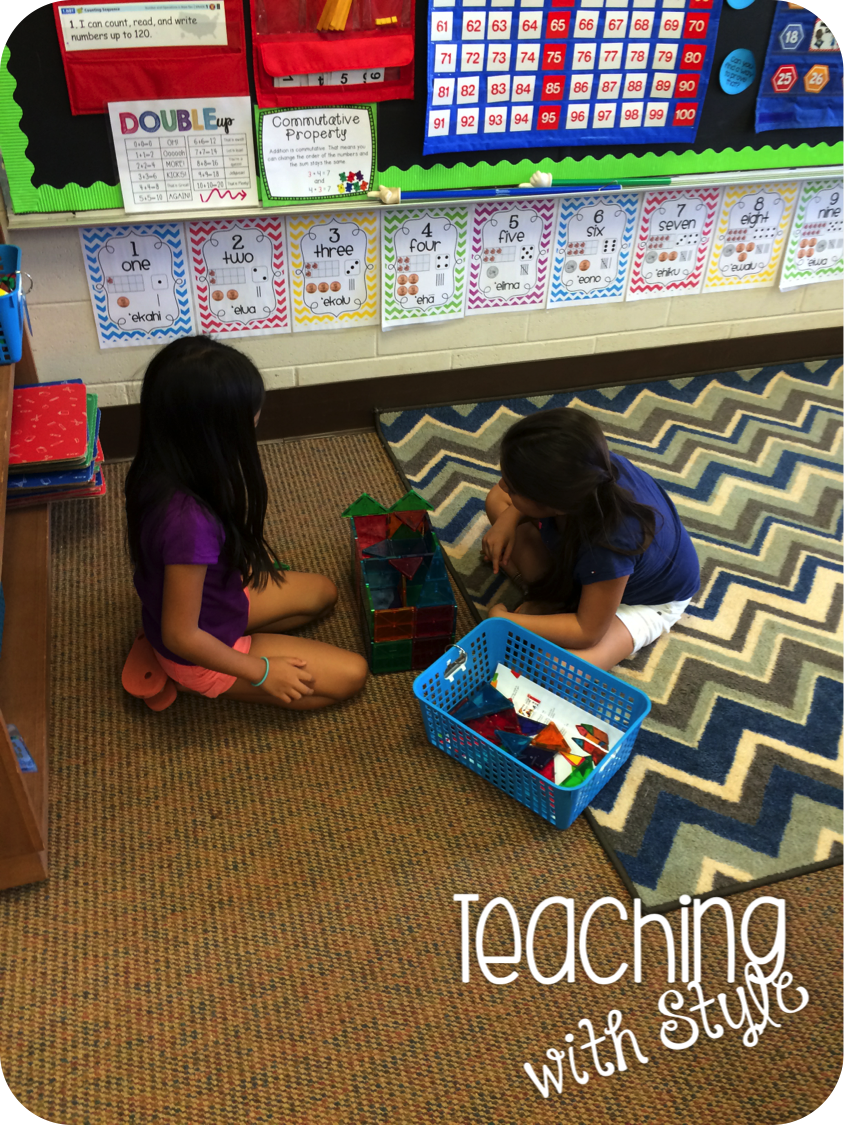
These girls picked Math Manipulatives and are building with Magnatiles.

These girls picked art.  They are painting with watercolors.

It's been busy around here! But we still manage to squeeze in some fun.  What has your class been up to during the past couple of weeks?


When the weather gets cool (yes, even in Hawaii!), my kids love to bundle up with a hot cup of cocoa.  At my new school, my teammates love to introduce and review math skills with craftivities, so I had to make one using hot cocoa mugs for the winter season!

The students will create a cocoa mug craft, then decide how many marshmallows they want to be inside the mug and how many they want dripping down the side.
Then, they will read the word problem and write their numbers into the blanks.  At the end, they will write a subtraction sentence that matches the craft.  On my sample, I had 7 marshmallows in total, with 4 in the mug and 3 melting down the side, so 7-3=4.  On Joshua's mug below, he had 9 total marshmallows, with 5 in the mug and 4 melting down the side, so 9-4=5.  


My school is big on including rubrics and descriptive feedback on student work that is hung in the classroom.  Because of this, I included rubrics with I Can Statements and a place for comments.  This can go below the mug, or even on the back of the work.

The I Can Statements are included for kindergarten, first grade, and second grade. 

My class has been working on Lisa's Print Think and Color no-prep winter pack for extra homework or quick center reinforcement.  And I stumbled on this page - it's a perfect follow up sheet for my craft! The kids color the mugs, then solve the problems on the marshmallows, color them, and glue them on the mug that is the answer.  As students finished up their mug crafts, they worked on this page.  It was perfect! Lisa and I must have been on the same wave-length! :)


Do you have any fun winter projects planned for when you get back from break?

Hello there! My Bright Idea for October is all about using these spiffy whiteboard dots for small group instruction! 


A few months ago I was making an OfficeMax run and happened upon these cool adhesive whiteboard dots, called Wall Pops.  They are made to go on a wall in an office or cubicle, but I thought "Hey, those would be cool on my guided group table!" 

So now, every time my students come to my table for either reading or math groups, they bring their marker and little eraser I got in the Target dollar section a few years ago.  

Here we are in reading, doing a little short e dictation warm up before reading our guided book.


In math we are working on number sense as well as basic addition.  I found these laminated ten frames in my room when I moved in this summer and they have been great for subitizing.  We've also been working with Rekenreks, so the kids are getting good at recognizing 5's and 10's.


We are also learning basic facts, including turnaround facts.  The kids loved using dominos and writing the turnaround facts! 
I love that these are quick and easy.  The kids love writing on the tables, making group time a novelty.  I love it when I hear them say, "Yes! Group time!"  You can do so many different activities as quick warm ups with these, the possibilities are endless!

If you liked my Bright Idea, please consider following me on Bloglovin' or Instagram! 

Don't forget to visit my friends in the hop and read all their awesome ideas, too!