Teaching With Style: Freebie

Showing posts with label Freebie. Show all posts

When I taught 1st grade, my school used the Wonders reading curriculum. This post is all about some ideas we used for Unit 3, Week 5 and the essential question “How do we get our food?”

Make sure to scroll down to the bottom for a fun freebie!
Find my Essential Questions on TPT

The stories focused on how milk gets from the cow to our morning cereal bowls and how foods we eat everyday are made. The interactive read aloud is the Little Red Hen (except they say she’s collecting corn – not sure why they changed it from the traditional story of wheat). The paired selection focuses on nutrition and the food groups.

During my science block, I tied in more nutrition lessons to help students understand the concept. We focused on this health standard from our Hawaii Content and Performance Standards: HE.1.3 Describe the benefits associated with a healthy diet.

I love using OCDE Project GLAD (R) strategies in my classroom, so I started our learning with songs and chants. I wrote a Bugaloo chant and taught it to my students. I write mine on chart paper and alternate the color of marker I use. The title is one color, the chorus another, stanza 1 another color, and stanza 2 is the last color. This helps students see the structure of the poem. Older students don’t need this color coding scaffold anymore. I teach the poem line by line, then we go through and identify “clunkers”. Those are words students either cannot read or do not know what they mean. I highlight the clunkers right on the chart paper and then teach the word by giving a definition, break it into chunks and show how to read it, and either draw a little sketch next to it, or create a little motion students can do the next time we read the poem that will remind them of the meaning. On the student copy, they draw sketches in the box of what they learned from the chant. It helps them process the new information.

I also use this free Nutrition Education poster from the Kokua Hawaii Foundation.

The next thing we did was a Healthy/Unhealthy photo sort. I passed out the photos to the students and had them turn to a neighbor to read the word and discuss if they had a healthy or unhealthy food. Then, one at a time, students came up to the chart and taped their food under the corresponding heading. A few of the foods were tricky (on purpose), like the fruit juice. Students thought it should be listed under healthy since it’s made from fruit. But then I told them how most commercial fruit juice from the store contains too much sugar, therefore making it unhealthy. Some of these foods might be controversial, like milk and dairy. Please use your judgement and research when approaching any foods. That's why I didn't create an answer key - this activity was a great way for my students to discuss what their family eats without judgement and we were able to confirm ideas through the text in our reading curriculum.

We ended the lesson with an exit slip (called a Learning Log in the OCDE Project GLAD (R) model). On the left side, students wrote and sketched one of the unhealthy foods and wrote why it’s considered unhealthy. On the right side, students wrote and sketched one of the healthy foods that they like and why they like it. Some of the sentence frames I had the kids use were:
________ is an unhealthy food because it has too much ___________.

A healthy food I like to eat is ________. It is healthy because ___________.
In a learning log, the text (or book) side is where students write about what they learned from the text. On the you (or smiley face) side, they make connections to what they learned. 

We also did an individual food sort freebie from True Life I’m a Teacher.

Next, we watched the BrainPOP Jr. video on the Food Groups. Using a plain paper plate, students drew a line down the middle, to divide the plate in half. They then drew lines to make the larger vegetable and grains sections and smaller fruits and proteins section. After we watched about each food group in the video, I paused and they drew foods on their plates. Susan Jones’ nutrition unit on TpT has a worksheet that would work well for this activity, too.

The last thing we did was to make our own food! I asked parents to send in 1 quart of heavy cream (a 1/2 cup each for 4 groups of 5 kids), oranges, whole grain crackers, and plastic knives. From home, I brought my KitchenAid mixer with the citrus juicer attachment and 4 mason jars with lids.

First we made butter. I poured a 1/2 cup of heavy cream into each mason jar, filling the jar up halfway. We added a spring of rosemary to each jar from our school garden. I screwed on the lids. Students got into groups of five and sat in a circle. I set a timer for 1 minute and one student in each group shook the jar. When the timer went off, they handed it to the person to the left of them (reinforcing “clockwise”), who then shook the jar for a minute. Each group went around the circle twice, continuously shaking the jar.

After their butter turned, I dumped out the buttermilk (my baker mother-in-law would be horrified!), then gave the kids a plate of crackers and a plastic knife for spreading their butter. We talked about how hard it was to shake up their butter, but also how this was healthier since we didn’t add any salt or sugar that is unhealthy for us. And how hard work pays off (like in the Little Red Hen) because now we have a delicious snack. 

Next we made fresh squeezed orange juice. I cut the oranges in half and the students got to press half of an orange onto the citrus juicer as it spun around. This is definitely easier to use than a hand press or handheld juicer. They each got about a 1/4 cup of juice, since we talked about how even though we didn’t add any sugar to our juice, that fruit juice has natural sugars and we don’t want to drink too much; this is only a treat. The kids had fun using the juicer.

The last thing we did was a lesson idea from my colleague Mel. We read the story Gregory the Terrible Eater. Then students wrote on writing paper about healthy and unhealthy foods. You could have them write a five sentence paragraph (maybe using the 4-Square method to plan it out) or sentence frames with a word bank. Then I gave them cut outs of fruits and veggie clipart from EduClips and they glued torn paper on top to create a collage. We added a little crayon-colored image of Gregory as a finishing touch (my colleague drew his outline). They came out beautiful!
My colleague Mel's pineapple example

This was one of the more memorable weeks for the kids due to all the fun extra lessons I added into our core curriculum. Grab my freebie with the Healthy Foods Sort (paper or digital), exit slip, and Nutrition Bugaloo!


How do you teach about nutrition in your classroom?


Part of the first grade standards for Hawaii state social studies is to learn about American Symbols! My teaching team puts together these adorable books that I want to show you and provide some resources for where you can put together your own!  I've included lots of pictures, lots of links to products and freebies that I use, and also a freebie I put together for you that you can download at the end of this post!


We start by singing a silly song I found on YouTube by KinderBlossoms.  We then do a simple foldable in our Science and Social Studies Books.


I use the organization idea from my gal Corinna at Surfin' Through Second to separate my notebooks.  You can download the song freebie here.


We then make US Symbols books that I prep and comb bind ahead of time.  We use a combo of pages from Lindsay at Teacher Bits and Bobs and craftivities.  Each day we introduce a new US symbol, write about it, and make a craft.  We start with the world's oceans and continents, then focus in on our state in the US, Hawaii.  I like to play a continents and oceans song from YouTube, too.  I can't find the one I usually play, but there are a lot of good ones if you search on the site.   


These are some of the crafts we've done in the past. 


However, I switched some of them up this year.  We made the eagle and Liberty Bell crafts from Mrs Ricca's freebie President's Day packet.


For the Statue of Liberty, I did a directed drawing.  I love this one from Art Projects for Kids and also this one that is just her head.  The kids' paintings turned out beautiful! The parents loved seeing this project at Open House!

Speaking of Lady Liberty, I like to throw in this fun experiment when we learn about her to find out why she is green if she is made out of copper.  The kids love it! I bought this pack and use the worksheets in our science and social studies journals from Kindergarten Boom Boom, and also these directions from Buggy and Buddy.  I printed this out and put it by our experiments during Open House.  You can download it here.

For the flag, I cut white rectangles as the background, smaller rectangles for blue, red stripes, and then glitter for the stars.  

For the Pledge of Allegiance, I use Lori's freebie, just shrunk down to fit on the page.

There are a couple pages we made ourselves.  That includes symbols for our state and school, the White House, the world, and an assessment.


We also did a Lady Liberty OCDE Project GLAD® Pictorial Input Chart.  I'm becoming an OCDE Project GLAD® trainer, so I try to practice the strategies any chance I get!  The kids were fascinated that you can walk inside the statue and see out from the crown! I also wrote a poem that I included in my freebie.  

Via Pinterest

You can download my freebie with a poem, interactive journal, crafts for the world, state symbols, and the White House, as well as an assessment for free on my Google Drive!

How do you teach the US Symbols? 


Summertime means prep-time for many teachers! If you are like me, you have tons of projects planned for the weeks you have off during the summer.  My main project: Leveling books.  My school uses Accelerated Reader (AR) and I wanted to label the books so kids could easily see the level.  

Looking around at other blogs, I was instantly drawn to my friend Jen from Teacher by the Beach's library.  She organizes hers by author's last name and nonfiction theme (like a real library!).  She also puts a sticker on the spine for the level.  Her current school doesn't use AR, so she has started to label her books with the Fountas and Pinnell system they use.  

Another library I love is Molly from Lessons with Laughter's library.  I LOVE her color coded system! Her chapter books are organized by author's last name, like a library or bookstore would do.  By color coding the spine, students know the vicinity of the book they are looking for or where to put it back.  It's just an extra scaffold. 

So when thinking about how to level and label my books, I wanted to combine the two ideas.  I created color coded spine stickers with levels in a grade-level range the same color.  My books are all organized by genre and theme, so the colors wouldn't ever be together, but if a student was interested in Captain Underpants books, she could find one easily in her level range by looking at the spine sticker.  

I printed my stickers on Avery address labels and cut them in half.  I store the labels in a grade-level range together with a paper clip. 

I looked up levels on the AR Bookfinder website and labeled each book accordingly.  

I put clear packing tape over the stickers so they last longer. 

These book are almost ready! 

To make it extra easy for the kids, I write the AR level, point total, and quiz number on the inside of each book.  When students are ready to take the quiz, the information they need is readily available. 


Want to label your books the same? I made a FREEBIE PowerPoint document that you can download from Google Drive.  Just download and print the pages you need onto Avery address labels.
Click the cover to download from Google Drive

How do you level or label your books?

Earlier I shared my K-1 Hawaii HCPSIII standards freebie. And like I promised, here is another grade added on! By the end of the week, I'll have added all grades K-5!

Now the freebie has:
  • Kindergarten - 
  • First Grade - 

  • Second Grade - 

I've included standards for:

  • Social Studies
  • Science
  • Health
  • World Languages
  • Physical Education
  • Career and Technical
  • Fine Arts

Head on over to my Google Drive and download!

And don't forget that I'm having a sale until the end of the day on Tuesday to celebrate going back to school on Wednesday!

Over in Hawaii, we all go back to work this week! In my district, kids start Wednesday! So to help everyone out, a bunch of other Hawaii teacher bloggers and TpT sellers have decided to throw a little sale!

And to sweeten the deal, I've updated my Hawaii HCPSIII standards sheets for you! Here are Kindergarten and First Grade:
    

I'll have the rest of the grades up throughout the week! 

Head on over to my store to see the sale! 


A few weeks ago, one of my colleagues and I attended a teacher training at the Honolulu Museum of Art.  We had to wake up early to head to the Maui airport, rent a car in Honolulu, then drive through morning traffic to the museum, and Honolulu is rated one of the worst traffic cities in the US!  When we first got there, we saw a giant photo of Princess Nahi‘ena‘ena outside.  She was the princess of the Hawaii Kingdom when the capital was on Maui, so she is special to us. 


The workshop claims that arts integration can strengthen Common Core implementation and better prepare students for the Smarter Balanced Assessment.  We got to visit the Lending Library, practice observation skills in the galleries with museum docents, and sample the curriculum-themed guided school tours.  

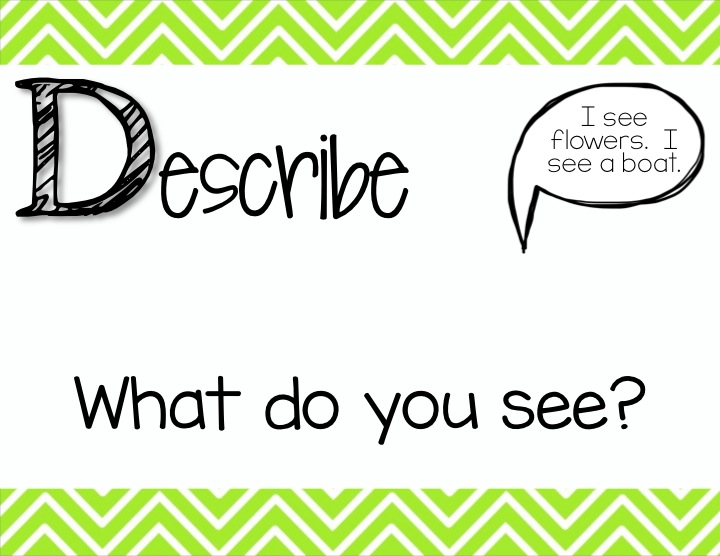
This fall, the State of Hawaii sent a poster to each public school teacher to help teach a visual literacy observation technique called ODIC: Observe, Describe, Interpret, Connect.  One of the museum educators told us that she watches people looking at art in the museum all the time and is shocked to see them only look for a few seconds before moving on to the next painting.  In the museum setting, that makes sense because they have so much art to see.  But in the classroom, we don't have to view as much art and can spend time looking at one piece of artwork at a time.  In the ODIC technique, students will first silently observe the art.  Ask themselves: What is the subject?  What is in the background?  Next, they will describe what it is they see, without and opinions or judgements.  After describing, they will interpret and say what they think the painting is about.  And last they will make connections to their lives or other things they have seen.  We did ODIC with the painting in the poster below, Lei Sellers by American painter Juliette May Fraser.  After observing quietly for a few minutes, we described what we saw.  Many thought the girl in the front looked bored.  Many noticed how the four people in the painting were looking in different directions.  Some noticed lei hanging in the top right background, some thought it was a tree.  In the top left background, many were unsure until one pointed out it was a boat, possibly a cruise ship.  That lead us to interpret that maybe the sellers were waiting for the cruise ship to dock before they could sell their lei.  I made a direct connection since I went on a cruise for the first time this summer.  It was quite fun to experience the art this way and to discuss the painting in this structured manner that helped us think critically for ourselves instead of just passively reading about the artist.  
This is the next painting that the museum will be turning into a poster.  It is called Study of Fish by Dutch painter Hubert Vos.  We did the same ODIC protocol around this real painting.  We noticed the vibrant colors of the fish.  We noticed that the fish were from many different areas of the ocean, some reef fish, some bottom feeders.  They also varied in size.  We noticed the lauhala basket that the man held, the net behind the table in the middle of the painting, and the large koa wood bowl in the right.  The man doesn't wear a shirt, so we interpreted that this was happened during pre-contact Hawaii, before the arrival of Captain Cook and the Western world.  After reading the card next to the painting, we learned that this was painted in 1898, so we were right about it being old! It's amazing that the colors are still so vibrant after more than 100 years! 

"In painting this carefully detailed representation of fifty-seven varieties of the fish and crustaceans that inhabit Hawaiian waters, Hubert Vos drew on the tradition of 17th-century Dutch still-life painting, with which he was doubtless familiar from his childhood and studies in Europe.  To create the composition, he sketched actual specimens of sea life that he purchased at the Honolulu fish market, giving careful attention to their richness of color and form.  An ‘umeke of kou wood, a draped net, and a woven lauhala basket locate this scene in pre-contact Hawaii. " 
Next, we learned a fun activity called Exquisite Corpse.  It started out as a word game played by surrealist painters in Paris during the 1920's.  The word game goes adjective-noun-verb-adjective-noun.  They would write a word, fold the paper over and pass it to the next person.  They would continue writing, folding, and passing through the whole pattern.  At the end, they would have a funny sentence.  The name came from a sentence from the first time the famous painters played: "The exquisite corpse shall drink the new wine." 

The museum collected some local artists and created works of art made in the same fashion.  They would fold a sheet of paper in thirds.  Draw on one section and leave only little lines over the edges, fold their section back and pass.  The next artist would use the little lines over the edges to start their drawing.  Once done, they would fold it once last time and pass it on to the next artist.  

Here is a sample of an Exquisite Corpse painting from the exhibit at the museum:

After looking at the art, we wrote sentences in the Exquisite Corpse fashion about the artwork.  We wrote one sentence, folded the paper and passed it on.  By the end, we had one sentence of our own and 2 of others in the group.   We read them out loud and the group had to guess which artwork we were writing about.   It was really fun! 

Here are the sentence on my paper:

Violent tornado swirling lost lives.
Colorful creatures destroyed corrupted grasp.
Graceful legs dance around the swirling stage.

I added a preposition to my sentence (around) and the docent told us that was ok :)

Our next stop was the Lending Library.  The museum has this wonderful room in the basement where teachers can go and check out artifacts to bring back to their classrooms.  They'll even mail artifacts to outer islands! The artifacts are arranged by country, so it ties really well into social studies and learning about different cultures.  We did an activity called See Think Wonder.  We each found one artifact that spoke to us.  We wrote what we saw, facts about the artifact.  Then for the Think section, we drew the artifact.  Under Wonder, we wrote questions about the artifact.

Here was my paper.  I chose a bronze head sculpture from Africa.  I definitely think this technique could be used in the classroom when observing artifacts or even pictures of artifacts from another culture.  Instead of just telling students about an artifact, students have to observe it and ask questions to figure out as much as they can on their own.

We also got to sample three different curriculum-based tours for classroom field trips to the museum: Math Through Art, STEAM @ the Museum, and Literature Through Art.

In Math Though Art, we got to play with Photo Voltaic paper and create designs in the sun.  We picked which manipulatives to put on our paper.  Then we laid it in the sun and let it sit for about 10 minutes. 
After the time was up, we dipped the paper in water and hung it up to dry.  After it dried, we could see the patterns.  It was really cool.
We also talked about perspective.  We looked down this hallway of the museum and counted the pillars.  We talked about how the closer ones looked bigger and the farther ones looked smaller.  We all got to sketch this hallway and practice drawing with perspective. 
We then went into an upstairs gallery for STEAM: Science, Technology, Engineering, Art, and Mathematics.  We looked at this mobile and tried to balance the sides and sliding the string on the stick.  It was a lot of fun to see that when you move the pendulum, you need more or less weight to balance. 
The red bag has more rocks than the blue bag because the string is closer to the red bag.
We then got some time to browse the galleries.  Remember when we saw the Princess poster at the front? Well, we also got to see the REAL Princess painting! And there she is with her brother, the famous King Kamehameha III.  That was really cool.

All in all, I LOVED this PD and the opportunity to visit the museum.  I can't wait to implement some of the strategies in my classroom! I decided to make posters for ODIC to put up in my room.  Then I can change the painting to display.  You can click any image below to download them for free!

https://drive.google.com/file/d/0BxwXr-yc3_LxZGFiOEJKckxMTmM/view?usp=sharing

https://drive.google.com/file/d/0BxwXr-yc3_LxZGFiOEJKckxMTmM/view?usp=sharing

https://drive.google.com/file/d/0BxwXr-yc3_LxZGFiOEJKckxMTmM/view?usp=sharing

https://drive.google.com/file/d/0BxwXr-yc3_LxZGFiOEJKckxMTmM/view?usp=sharing

https://drive.google.com/file/d/0BxwXr-yc3_LxZGFiOEJKckxMTmM/view?usp=sharing

How do you incorporate the arts in your lessons?