Teaching With Style: ESL

Showing posts with label ESL. Show all posts
I just finished up teaching about magnets and want to share my new unit with you!

First off, I had to organize the old magnet bucket my teaching partner loaned me.  What a mess!  I spent a good 2 hours sorting and organizing all the magnets and materials before I could even start!


Then, to get started, I wanted to jazz up the unit with some OCDE Project GLAD® strategies (Guided Language Acquisition Design - a great way to teach ELLs and all students!).  One of my favorite pictures books about magnets is Mickey's Magnet by Franklyn M. Branley.  


The only problem with this book is that it's out of print, so any copies you are going to find are going to be old.  I was lucky enough to find two copies of the book from used book sellers.  Then, I cut them apart.  I know, I know, it sounds crazy!  Why would I do that?  Keep reading :)


I turned the books into a Narrative Input!  This strategy is a fun way to teach concepts using picture books.  Taking two copies of the book, you cut out the words and glue them onto the back of each of the pictures.  I then laminate each page.


Then, as you read the book and show the picture, you tape the picture up on the wall for the students to see.  This way, they have a visual of the entire book. This approach makes it really easy for kids to practice retelling and sequencing the story.

You can read more about Narrative Input in OCDE Project GLAD® creator Marcia Bretchtel's book Bringing It All Together.

Now, on to my new unit that I used to teach magnets!

I started off with some vocab cards:

And vocab books to teach the words via the Marzano way.

Booklets to explore the Scientific Method:

Seven experiments for hands-on learning:

Four nonfiction articles to teach about lodestones, compasses, temporary magnets, and electromagnets. You can use these whole group or in small groups.  I even included a packet cover if you decide to make a small packet of the articles and comprehension questions for your students.

Students choose one of the article topics and write a short research report.

And there are some extras, too!  A world map to go with the nonfiction articles, a word search to go with the vocab words, a KWHL (the H is for "How will I find the information"), and a Can, Have, Are sheet.

Make sure to head over to my Teachers Pay Teachers store to check it out!  A free copy of a generic vocab page is included with the Preview download!

Here are a couple of my students enjoying the experiments!

Make sure to download the Preview in my Teachers Pay Teachers store to get your copy of the vocab sheet!


The district I work in is extremely diverse.  There are over 25 languages spoken in my school!  Because of this, all teachers in my district have to be very savvy to strategies for teaching English Language Learners.  You already know about my obsession with OCDE Project GLAD® and my work with Systematic ELD, so this summer I decided to take a couple grad school courses to finish up my ESOL endorsement.  I've been teaching with ESOL strategies for six years, but knew that the endorsement would bring me some more ideas and tools to use in my classroom.

The main model for instruction that my class is focusing on is SIOP: Sheltered Instruction, Observation Protocol. Here is the SIOP website: http://www.siopinstitute.net/

Most research claims that this kind of teaching is also good for students from poverty, since their language levels are significantly lower than their middle class peers.  Since my school is both high poverty and high EL, this is a must for me!

A SIOP lesson has eight components, and I found some great YouTube videos to explain each one.  Click on the link below to watch them.
  1. Lesson Preparation
  2. Building Background Knowledge
  3. Comprehensible Input
  4. Strategies
  5. Interaction
  6. Practice/Application
  7. Lesson Delivery
  8. Review/Assessment

What other resources do you have for Sheltered Instruction?  Do you have ELs in your class?  What kinds of strategies do you like to teach with?

Some colleagues and I visited an amazing school today in Salem, Oregon: Myers Elementary.  They have been integrating their ELD instruction into the regular subjects instead of doing a 30 minute pull-out model like my school currently does.  My district recently cut all ESL teachers, forcing us to jump into this integrated model a bit faster than we had anticipated.  I really do believe that ELD integration is the way to go: teaching students ways to explain their thinking that they will use all day long, instead of isolated skills that are only applicable to ELD time.

Here are some pictures I snapped while at Myers today.  Notice the use of anchor charts, sentence frames, and OCDE Project GLAD® strategies.

A kindergarten room - working on making observations

CAFE writing board in kindergarten

CAFE reading board in kindergarten

Character trait anchor chart in kindergarten

Words to know by heart

Harder heart words

2nd grade room - Writing is kind to readers/ Reading is kind to writers!

2nd grade CAFE board - love the wooden letters! 
2nd grade teacher filling out a KWL, but instead of "Know" it's "What I think I know"
1st grade CAFE board - no robot reading!

ea anchor chart

Bossy e anchor chart

Academic sentence frames for the calendar area

Teaching inference with nursery rhymes

More inference with nursery rhymes

Good Writers anchor chart

Writing stages anchor chart
More anchor charts

"Beautiful Beginnings" and "Terrific Transitions"

Author's Purpose anchor chart
Systematic ELD anchor charts - telling time

Word Work bags

Systematic ELD strategy - Turn and talk

More observations - but supported with sentence frames

Math Workshop - kind of like a CAFE board

3rd grade CAFE board with Daily 5 rotations below on the magnetic boards

Daily 5 rotations

Math activity - fractions worksheet with models

Fractions games for partner work

Math Workshop rotation chart - colors match the Math CAFE board

Sentence frames for being nice to each other!

More CAFE boards

Another way to set up a rotation schedule

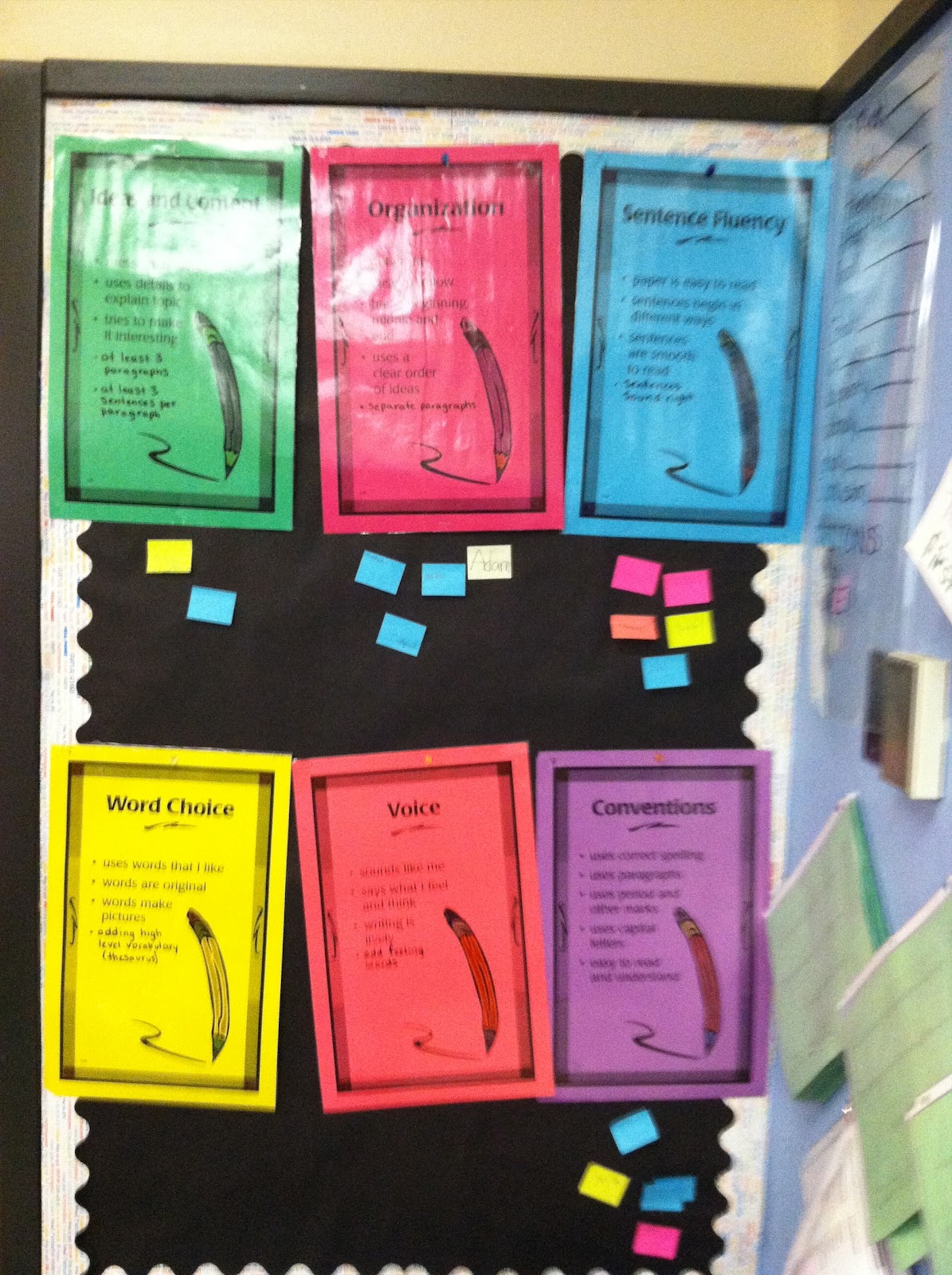
Writing CAFE board with the 6 Traits

Math vocabulary cards with sentence frames

KWL for fractions

Cognitive Content Dictionary in a 4th grade room

CAFE board on a cabinet
Math Workshop rotation board
Wasn't that awesome?? They do reader's workshop, writer's workshop, and some have started using the workshop model in math.  It was a fabulous school and a great way to learn by being there.  Have you visited any great schools or classrooms lately?

I'm linking up with Tessa from Tales From Outside the Classroom!